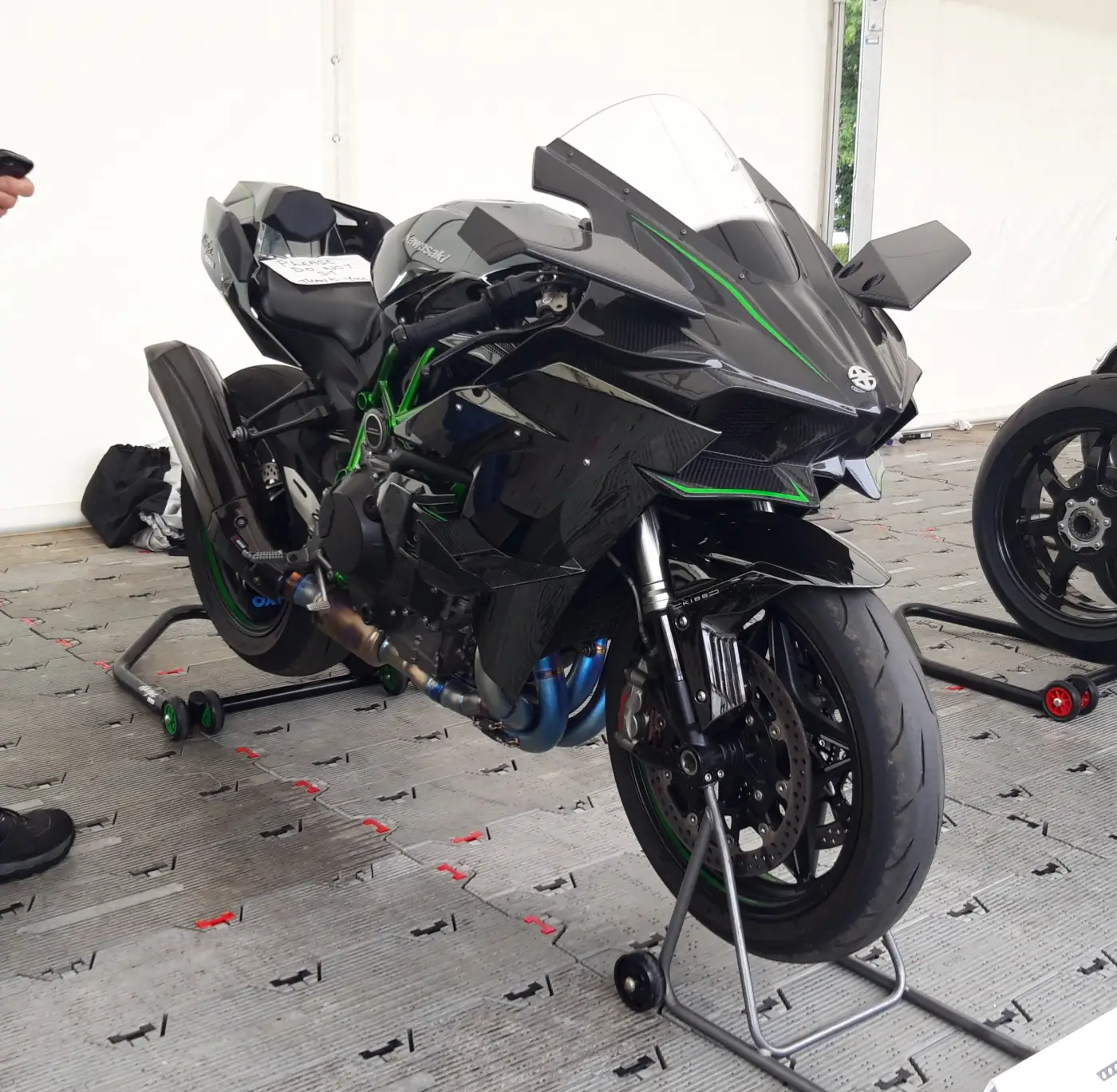
Kawasaki Ninja H2R
A closed-course superbike people ask about as a drag project. The factory page has a price and a power figure, and no drag elapsed time.
Back to all builds.
Wikipedia, citing Kawasaki, describes a 998 cc supercharged inline four. Peak power is 310 hp, 230 kW. With ram air the same article lists 326 hp, 243 kW. The United States Kawasaki page for the 2027 Ninja H2R ABS shows an MSRP of $64,300 and says the bike is for closed courses, not the street. That combination — capacity, supercharger, two power figures, price, and the closed-course limit — is the sourced core.
A drag conversion is a search, not a case file. I do not have two independent write-ups of one finished H2R drag chassis with a time slip. The page therefore talks about what you would be starting from, not about a named bike’s ET. Anyone budgeting a project can at least start from the MSRP. The bike is already $64,300 before a swingarm, a wheelie bar, or a different gearset, and those extra costs are not on the factory page. I am not inventing a build total. A separate search about a “ride storm” total cost did not produce a second document I could open, so that phrase stays out of the table.
Compare the money with two other bands on the cost page: a mini-bike drag frame at a few hundred dollars, and a Top Fuel build King Racing puts above $80,000. The H2R sits between them as a factory closed-course motorcycle, not as a nitromethane chassis. The Silver Bullet TL1000 is the opposite approach, a donor bike stripped and re-framed, and it has its own story.
Questions
What is the H2R’s official top speed?
Kawasaki’s US page does not print one. I am not using the 400 km/h figure that circulates elsewhere.
Can it be registered for the street?
Kawasaki labels the H2R closed-course only.
Sources
- Kawasaki USA — Ninja H2R — checked 2026-11-17
- Wikipedia — Kawasaki Ninja H2 — checked 2026-11-17
Photo credits
- 2019 Kawasaki Ninja H2R FOS19 by MrWalkr, CC BY-SA 4.0, via Wikimedia Commons. Resized and converted to WebP; this image version is shared under the same license.
- Stark Future - VARG by Herodotptlomeu, CC BY-SA 4.0, via Wikimedia Commons. Resized and converted to WebP; this image version is shared under the same license.

